Smart Mirror Guide 2026
Smart Mirror for Fashion & Boutiques: The Complete 2026 Guide
A smart mirror turns an ordinary mirror into an AI-powered stylist: customers see themselves – and, with one tap, in a new outfit, a different colour, or a complete AI-styled look. This guide covers how the technology works, what it costs, which providers exist, and when a smart mirror pays off for your boutique.
Key takeaways
- A fashion smart mirror combines a display, a camera, and AI into an interactive mirror with virtual try-on.
- Entry is now possible from ~CHF 1,200 in hardware plus a software subscription – expensive custom hardware is no longer required.
- Main in-store effects: more try-ons, bigger baskets through upselling, fewer returns, and social media reach through shareable looks.
✦ Free download
The complete smart mirror guide as a PDF
Every chapter of this page in one compact file: technology, costs, provider overview and the 5-step checklist for your boutique.
No spam. We only reach out with relevant info for boutiques.
What is a smart mirror?
A smart mirror (also called a magic mirror, interactive mirror, or AI mirror) is a mirror-format screen that shows a live camera feed enriched with digital features. In fashion retail this means: customers step in front of the mirror, see themselves as usual – and can virtually try on pieces from your collection, switch colours, or get honest AI feedback on their outfit.
There are two hardware approaches:
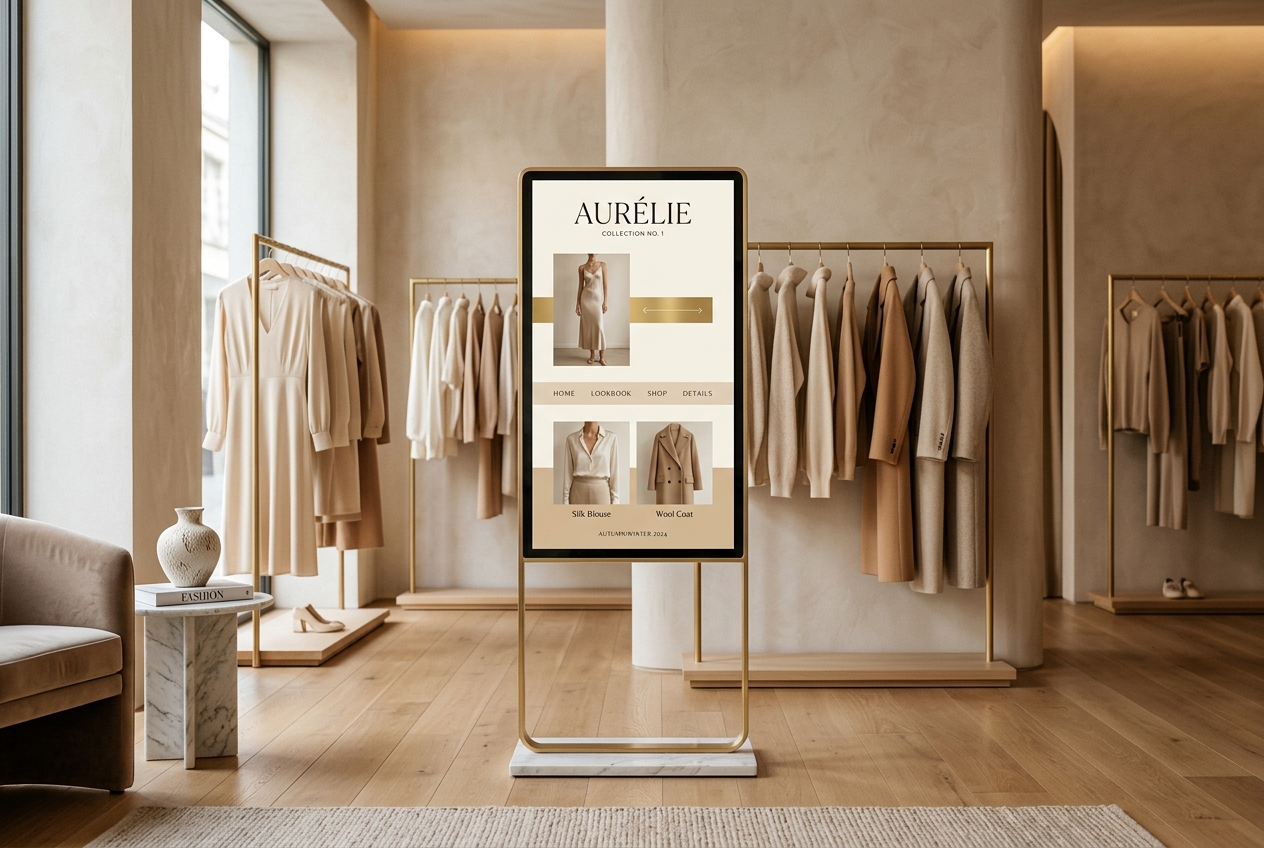
- Display mirror: A portrait-mounted LCD screen (e.g. 55 inches) shows the camera feed in real time – looks like a mirror, is actually a screen. The most affordable and flexible option.
- Two-way mirror: A semi-transparent real mirror with a display behind it. Looks like a normal mirror when off – the most elegant but more complex option. More in the glossary.
How does a smart mirror work in a boutique?
Modern solutions like Mira Mirror no longer need custom hardware. The setup has three parts:
- A 55" LCD screen in portrait mode – wall-mounted or free-standing with a base. Any off-the-shelf model works.
- An iPad or Android tablet in front as the control station: it provides the camera, touch input, and the AI app.
- Wireless screen mirroring to the large display – the customer experiences everything in full mirror size.
The AI does the rest: it detects the person, photorealistically renders garments from the boutique's collection onto their body (virtual try-on), analyses colour impact and style, and suggests matching add-on items. Full numbers: smart mirror costs.
What a smart mirror does for fashion retail
- Virtual try-on: See any piece from your collection directly on the customer – no fitting room needed. Changing colour or swapping pieces takes seconds. How virtual try-on works.
- Honest AI style analysis: The mirror rates outfit, colours, and presence – lovingly honest instead of flattering. That builds trust and starts conversations.
- Complete look: The AI composes a full outfit from your stock and tries it on virtually – a digital personal shopper.
- Upselling after analysis: For the outfit the customer is already wearing, the mirror recommends matching pieces from your inventory – the strongest lever for bigger baskets.
- A look to take home: The finished look collage goes to the customer's phone via QR code – and from there, often straight to Instagram. Free marketing with your boutique's branding.
- Inventory in minutes: Products are scanned by barcode; the AI fills in descriptions, colours, and details automatically.
What does a smart mirror cost? (2026)
The price range is wide – the deciding factor is whether custom hardware is required:
| Item | Indicative price |
|---|---|
| Mira software (all AI features, updates included) | CHF 149 / month, 30-day free trial |
| 55" LCD (off-the-shelf) + iPad or Android tablet | from ~CHF 1,200 one-time |
| Wall mount or free-standing base | your choice, standard hardware |
| Optional: Mira-design mirror frame (two-way mirror) | ~CHF 1,000 one-time |
For comparison: international enterprise solutions with custom hardware and agency installation typically start at CHF 10,000–30,000 per unit – built for flagship stores of large chains, not owner-run boutiques. All details: smart mirror costs & sample calculation.
Is a smart mirror worth it for your boutique?
A smart mirror pays off through four effects:
- More try-ons, lower friction: Many customers avoid the fitting room. Virtual try-on lowers the barrier – whoever has seen themselves in a new look is more likely to try it on for real and buy.
- Higher average basket: Matching add-ons are suggested at the right moment – by the mirror, not by staff. It feels less pushy and works even when the store is busy.
- Social reach: Every shared look collage carries your boutique into your target group's feeds – organically and free.
- Experience differentiation: Brick-and-mortar wins against online shopping only with experiences that don't exist online. An AI mirror is exactly that – and word spreads.
With just one additional item sold per day, the entry setup typically pays for itself within the first quarter. Full sample calculation: is a smart mirror worth it? The ROI math.
Smart mirror providers in 2026: the landscape
The market splits into three groups with very different budgets:
- Enterprise/agency solutions (e.g. DRESSX Mirror, INDE Vyu, Kivisense): custom installations for flagship stores and brand activations. Powerful, but expensive and project-based.
- Software platforms (e.g. Banuba, LookCheck): AR software for existing displays, mostly focused on overlay try-ons (AR filters), integration on your own.
- Complete solutions for boutiques (Mira Mirror): standard hardware plus ready-made AI software with inventory management – built for owner-run fashion boutiques, from Switzerland.
Detailed comparison with strengths and weaknesses: smart mirror providers compared.
Build it yourself or buy?
DIY smart mirrors (Raspberry Pi + two-way mirror) are popular home projects – but for store use they lack virtual try-on, inventory integration, and support. The realistic middle path: source standard hardware yourself (LCD + tablet), software as a subscription – investment stays small and the tech stays current. How-to: build a smart mirror.
Your boutique's smart mirror in 5 steps
- Pick the spot: a well-lit area near the fitting rooms, ~1 × 2 m, power outlet.
- Source hardware: 55" LCD (portrait-mountable) + iPad or Android tablet.
- Install the Mira app and scan your collection by barcode – the AI fills in the details.
- Mirror the screen, select rotation mode, test run with your team.
- Announce the launch: window sticker, Instagram story, invite local press – the novelty is your strongest marketing moment.